

All cultures gather around food to celebrate, and my Filipino American family is no exception. We love to celebrate every occasion! It gives us reason to get together around the table and enjoy sustenance while the elders gossip and the younger people chatter. The Filipinos diaspora reliving their lives back home, the latest winnings from playing slot machines in the local casino, careers and travels and the latest bar or restaurant in town. And it’s not complete without the karaoke and dancing.
Creating an Experience
Since my family loves to entertain, I’ve carried on that tradition but have upped it a notch. When I do my own gatherings, I aim to be more creative with using all my skills in interior design, culinary arts, and event management. I have, however, done away with the karaoke (personal preference). Instead, I want my guests to enjoy a unique space that I create just for that occasion and so that they might get comfortable and have a sense of enjoyment throughout. I want to create that “wow factor” through evoking the senses: smell, sight, sound and taste. My one rule is to only share positive stuff, no negative gossip or complaining. I also have a tradition where each guest is asked to write a little gratitude on a card I provide, and then drop it in the huge glass vase in my living room.
I love to have a theme for these get-togethers because it’s fun and easy to create your menu and props around it. Usually I focus on my recent travels or some event that’s interesting to recreate and which isn’t too complicated. If it’s a potluck (which seldom happens unless I’m short on time), then I ask my guests to bring something that is aligned with my menu, or an alternative if it’s too much for them to bring or make. Wine or dessert is always easy. Often they’ll also ask if they can be of help in preparing some of the dishes, or just come early to help, which is always appreciated as it speeds up the work. Then we can have more time for feasting, sharing stories, and making memories.
Connecting to My Roots
Being a first generation Filipino American, I gained exposure to western culture even before coming to the States. But I became more westernized and adapted to American culture when we moved to the US, and I totally abandoned my own culture in trying to assimilate into society. After many years here, and making diverse friends from different cultures, I’ve been missing some parts of myself, my heritage, and my roots.
Except for my immediate family, those closest to me are mostly non-FilAms who have little knowledge of Filipino culture and cuisine. And seeing as I just came back from a long-awaited trip to Manila, I decided that I want to embrace my Filipino culture and showcase it in my next get-together.
Filipino cuisine is a fusion of cultures, being under Spanish rule for about four hundred years and then about four years under the Americans after that. Although it’s a fusion, it’s not so well known in the US, and many of my friends only know of lumpias (fried spring roll), pancit (traditional noodle dish), and adobo (not to be confused with the hispanic adobo rubs or marinades). A Filipino adobo dish will never be complete without the fragrant laurel leaves that have a mediterranean origin. It involves a cooking process by stewing meat, seafoods or vegetables in vinegar with soy sauce, garlic, bay leaves and black peppercorn. Cooking them with vinegar helps keep the dish longer, especially in tropical weather.
There’s another Filipino dish that was influenced by Spain and North Africa called escabeche. This is my mom’s favorite and it became mine, too. The Filipino version is whole deep-fried white fish marinated with sweet and sour sauce with sauteed ginger, onion, and sweet bell pepper or carrots on it. This is good for a family style feast and makes for a beautiful presentation because of the colorful garnishing.
Our main staple, however, is the mighty rice and no meal—not breakfast, lunch, or supper—is complete without it. I have a little nephew who once asked my tall and lanky friend who is of European descent what it was that made him so tall. He asked if it was because of rice. When we were kids, our parents would tell us to eat rice to help us grow, so it made sense to him that rice was the reason behind my friend’s height. (As we get older and start gaining weight, we tend to blame that on the rice, too!)
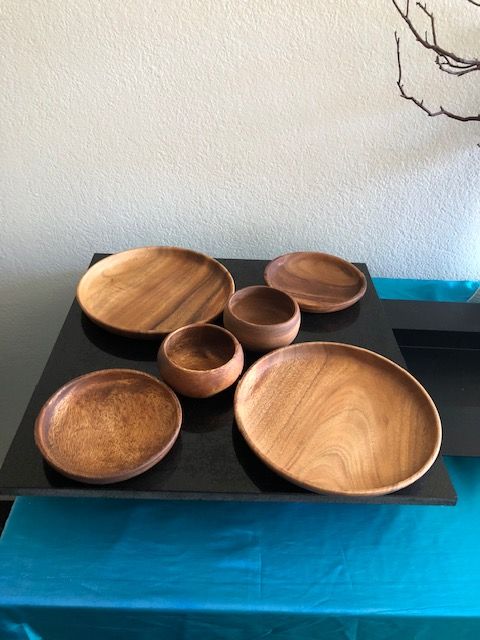
To create a warm feeling for my event I like to use wood, and acacia foodware is perfect for this purpose. In the Philippines it is widely used for things like furniture, boats, tool handles, carvings, and of course foodware. (It was disheartening for me to learn, however, that the acacia tree is not actually native to The Philippines but was introduced during the barter era.) Acacia has naturally fine texture and highly scratch resistance and can vary in color from light amber to dark mahogany. No two slabs are alike. For the most important part, it can repel liquid penetration & pungent garlic or onion odor, so it is particularly ideal for dishware.
Setting the Table
The first thing I do when I have a gathering in my place is sketch my setup – what’s going to be on the table, my menu, and a seating plan complete with name cards. I always prefer seated dining with assigned seats over buffets unless it’s an occasion such as an open house, or when I held a special rosary prayer tribute to my mom after she passed. I try to seat couples together, and for those who have come alone I seat them with another person who shares similar interests. By doing a seated dinner in this way, I can speed up the whole process of getting everyone settled in, and I have a sense of completion when I visualize the final outcome.


Preparing the Food
Your event does not start when you turn on your stove. It starts much earlier, the moment you start planning it. There’s easily a week of figuring out the menu, then picking up your produce two days prior to your event, and picking up your perishable foods like fish or shrimp the day before. My guests know that I lean towards being vegan, yet I still incorporate seafood for my more carnivorous guests, and just have another person tasting it for me after I prepare the marinade.
I start making the desserts first, especially if one can stand at room temperature in a tightly sealed container. Then I go to the next dessert that may need a day of refrigeration to set. I gather all my condiments for my coffee and tea service: creamer, sugar and the accessories that go with it. If I need to freeze something for my appetizer, I prepare them two days before and fry or bake on the day of. The rest of the ingredients I cut and dice earlier in the day.
It’s important to try to time everything, but it’s okay if you come out short because the guests can help finish and/or plate the food. Besides, it’s more fun if you allow your guests to be part of the process.
The Day of the Event
I usually tell my guests they can come between 4:30 – 5:00 pm, and I make sure that everything is ready by then: the powder room, the table, and food cooking at the right time. If I’m still finishing up when they arrive, they’re welcome to help, or just relax and have a glass of wine.
Before we eat, I ask everyone to write something they are grateful for on the back of their name card and drop them into my giant glass vase. Then we can all be seated and enjoy the meal while we talk about various interesting topics (but nothing about religion or politics!). With these Filipino dishes I would also tell a little something about the ingredients. Then after we have the main course, I’ll clear the table and maybe my friends would help brew some coffee and serve the plated desserts with the coffee, tea or more wine. When we’ve finished, I like to break out my Table Topics cards to encourage further interesting conversation.


What It’s All About
Inviting family or friends for a simple meal shows that cooking as well as entertaining is within reach for everyone. If it feels like too much for you to handle alone, invite your guests to get involved by helping you prepare or by doing a potluck. And who knows? They may get inspired and eventually pass that kindness to others by making something similar for their own friends and family to enjoy.
My ultimate goal in creating an intimate dinner like this is to give my guests a full sensory experience, and to let them feel that they are being taken care of so that they can just enjoy the moment. It’s all about what happens at the table as we talk and eat: the food brings us together, but the laughter and storytelling are what makes it memorable.

Sketch of my Filipino family Thanksgiving dinner
 Homepage
Wow and definitely informative.. well done Eve😊
LikeLiked by 1 person
Thank you Peggy!
LikeLike
Wow! This is the reality of what you’ve been telling me about what you wanted to do. You are better than beong good at your craft. I give you a YES. Ang galing mo.
LikeLike
Thank you Gwen!
LikeLike